

Ghana education is now said to be in crisis.
An “Early Grade Reading Assessment” conducted by the Ghana Education Service has revealed that 98% of primary two pupils can neither read nor understand English.
Over 7,000 of the candidates who sat for the 2014 West Africa Senior School Certificate Examination reportedly failed in all subjects.
And the country’s education at all levels is said to be below international standards by the World Economic Forum (WEF).
The Education Ministry has assured parents that it is doing its possible best to solve the challenges.
Among the initiatives being adopted is the introduction of a “reading hour” into the curriculum of the 9-year basic education of all schools at the beginning of the 2014/2015 academic year.
The Acting Director of the GES, Charles Aheto Tsegah told Citi News, the addition has become necessary due to the falling standards of education in the country; a situation he attributed to the bad reading habits of children.
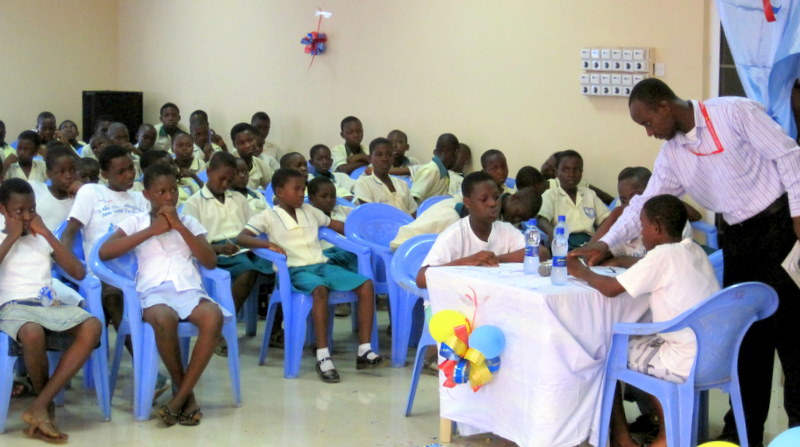
He announced the measure at the grand finale of Citi FM’s 2014 Write Away Contest where Marilyn Nana Yaa Gyan of Falsyd Foundation School emerged winner.
In an interview with Citi News, Mr. Tsegah mentioned that the Education Ministry would convene a meeting for all Directors of Education to enable them draw up a road-map to ensure reading becomes number one priority in schools.
“They [Directors of Education] will be made to create slots in their timetables for silent reading; so this academic year, we will start doing that in all public basic schools and in all private schools,” he explained.
He acknowledged that in some private schools, reading times and library periods have been allocated on their timetables “so that is done and dusted.”
According to him, it has come to the notice of the managers of Ghana’s education system that the biggest challenge is access to reading materials, but he was hopeful that enough books would be made available for onward distribution to all basic schools across the country.
He however disclosed that in 2013, the GES introduced “a set book for junior high schools” which was strategically named “Cockcrow because for us, that was the dawn of the beginning of a conscious [effort]to introduce reading literacy in schools.”
In a related development, an educationist, Anis Hafar, has advised parents to take keen interest in their children’s education
He said it is critical for parents to “be very clear on what it is that their children are studying in school by discussing their subjects…and we should get them [children]to explain to us what it is that they do, and we need to take interest.”
He again recommended that parents should create a space in their homes [a workstation]for their children to study.
“It should be a place where the child can sit and concentrate…it should be a place where all the books are, where all the pencils are and where the computer is,” to reduce the amount of time children spend looking around for particular books to study.
Mr. Hafar was convinced that if this workstation was created, it would enable children to concentrate on their academic work because “the more young people get to concentrate, the brighter they get.