

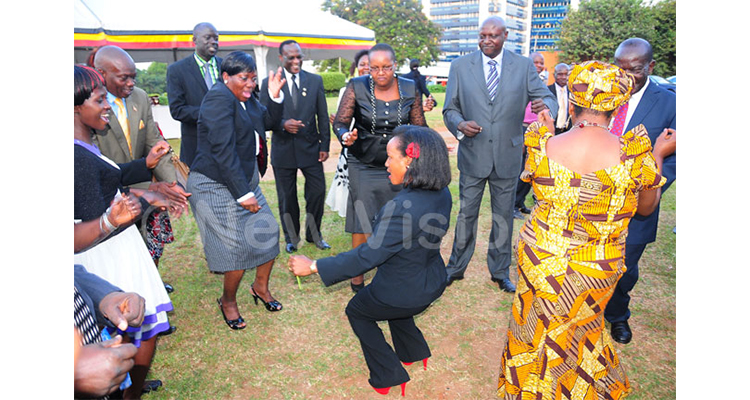
There were boisterous dance moves on the floor of Parliament of Lesotho last week as opposition MP celebrated their return with song and dance.
The dancing erupted as King Letsie III of Lesotho stepped out of the House shortly after re-opening Parliament after a four-month forced closure.
Lesotho Prime Minister Tom Thabane suspended sittings of the house in June to forestall a vote of no-confidence designed to sack him from office. The situation was exacerbated by an attempted coup on August 30 that forced Prime Minister Thabane to flee to South Africa.
That coup attempt had apparently been triggered by the PM firing of the Lesotho Defence Force Commander, Lieutenant-General Tlali Kamoli, who refused to relinquish his command is still at post.
Thabane could only return accompanied by Southern Africa Development Community police and officials, led by South African Vice-President Cyril Ramaphosa, who have since worked out a peace deal among Lesotho’s contending parties actions.
The opposition undertook not to mount a no-confidence vote against Thabane while this Parliament is in session, purposely to pass the budget.
The re-opening of Parliament is an important first step in a peace deal evolved by Ramaphosa and will lead to early elections in February 2015.
The king, who is a constitutional ceremonial one, thanked the international community – and particularly the 15-nation SADC – for helping to defuse the crisis.
“On behalf of the Basotho nation, I would like to express … our deep-rooted gratitude for expeditiously coming to our assistance at this critical moment in our political journey,” the King Letsie told the 120-member chamber, as the SADC meditator Ramaphosa, looked on.
As the king filed out, followed by Thabane, his feisty opponents, led by former Prime Minister Pakalitha Mosisili, then filled the floor, singing and swaying.
“Democracy begins again,” said one of them, Kotiti Diholo of the Democratic Congress. “There was no longer democracy in this country but now we can get back to representing our people”, and though unstated, getting their salaries again.
On August 30 Thabane fled the tiny kingdom, entirely surrounded by South Africa, hours before the military attacked police installations, in what was seen as part of an orchestrated putsch.
However, following Ramaphosa’s efforts, the soldiers have allowed the parliament to re-open and to pass a budget, then officially dissolve in order for the country to prepare for early elections next year
But the re-opening was without the military parade that traditionally opens Parliament as officials cancelled it at the last minute.
That cancellation papered over the crisis as to who is the head of the Armed Forces: Gen. Kamoli is not interested in stepping down and his nominated successor can only move in town under the protection of South African police guards following an attempt on his life during the attempted coup.
Though Prime Minister Thabane has succeeded in dodging a vote of no-confidence, he could lose the forthcoming election and his grip on power.
The opposition Democratic Congress is already the single-largest party in Parliament and has seduced the party of Deputy Prime Minister Mothetjoa Metsing – which is part of Thabane’s coalition government, to join forces with for the next year’s elections.
But the dancing left Lesotho’s Minister of Home Affairs, Joang Molapo, unmoved
“This is false bravado,” he said. “They always make a lot of noise. But we on the other side know how the deck is stacked.
“And we know that the Basotho people recognizes who has been the destabilizing element in this country.”
Molapo suggested the root cause of the crisis has been corruption – and resistance to Thabane’s crusade to expose it during the two years since he created one of Africa’s rare coalition governments.