

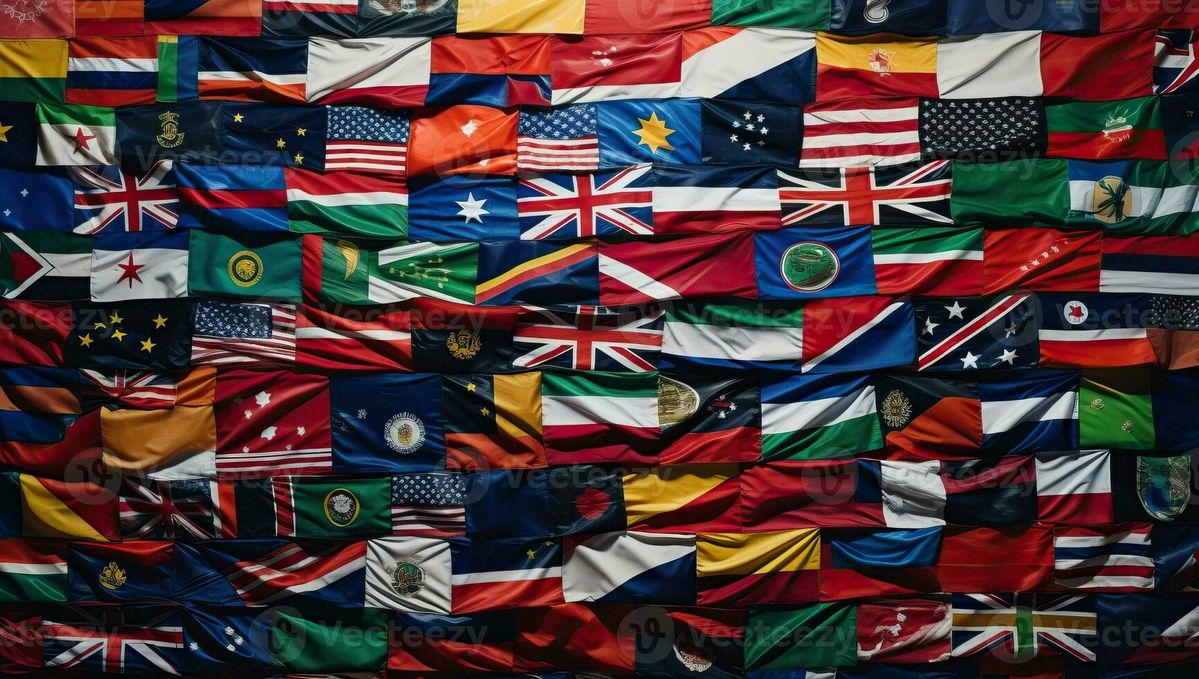
At first glance, the world’s national flags appear wonderfully diverse. Yet a closer look reveals that many countries have remarkably similar flags. This often leads to confusion during international sporting events, diplomatic meetings and even in classrooms. While some similarities are simply coincidental, many are rooted in shared history, political alliances, cultural identity or geography.
Understanding why certain flags resemble one another offers a fascinating glimpse into the stories behind the nations that fly them.
- Romania and Chad
Perhaps the most famous example is Romania and Chad. Both countries use a vertical tricolour of blue, yellow and red. The only noticeable difference is that Chad’s blue is slightly darker, although this distinction is often difficult to spot from a distance.
Romania adopted its modern flag after the fall of communism in 1989, removing the communist coat of arms from the centre. Chad officially adopted its flag in 1959 after gaining independence from France. Despite the striking resemblance, neither country has changed its design.
- Indonesia and Monaco
Indonesia and Monaco share almost identical flags consisting of two horizontal bands, red above white. The only practical difference is the flag’s proportions. Indonesia’s flag is slightly longer.
The similarity has historical roots. Indonesia traces its colours to the Majapahit Empire, a powerful kingdom that flourished centuries ago. Monaco’s red and white colours come from the House of Grimaldi, the royal family that has ruled the principality for more than 700 years.
When Indonesia adopted its flag in 1945, Monaco protested, but Indonesia successfully argued that its design had much older historical origins.
- Ireland and Côte d’Ivoire
The flags of Ireland and Côte d’Ivoire both feature green, white and orange vertical stripes. The difference lies in the order of the colours.
Ireland’s flag begins with green on the left, followed by white and then orange. Côte d’Ivoire reverses the arrangement with orange first, followed by white and green.
The symbolism also differs. Ireland’s green represents Irish Catholics, orange represents Protestants associated with William of Orange, and white symbolises peace between them. Côte d’Ivoire’s colours reflect the country’s savannah, peace and forests.
- Luxembourg and the Netherlands
Luxembourg and the Netherlands both use horizontal stripes of red, white and blue. Luxembourg’s version features a lighter shade of blue, while the Dutch flag uses a darker navy blue.
The two countries share historical links dating back to the nineteenth century, when they were connected through a personal union under the same monarch. Although there have been discussions in Luxembourg about adopting a more distinctive flag, the current design remains in official use.
- New Zealand and Australia
Australia and New Zealand have long been mistaken for one another because both feature the Union Jack in the upper left corner and stars representing the Southern Cross constellation.
Australia’s flag includes a large Commonwealth Star beneath the Union Jack and has five stars in the Southern Cross. New Zealand’s flag displays only four red stars with white borders.
The similarities reflect both countries’ British colonial heritage and their location in the Southern Hemisphere.
- Norway, Iceland, Sweden, Denmark and Finland
The Nordic countries all share the distinctive Scandinavian Cross, a horizontal cross that extends to the edges of the flag with the vertical section positioned slightly towards the hoist.
Although each nation uses different colours, the common design reflects their shared cultural, historical and religious heritage. Denmark’s flag is considered the oldest continuously used national flag in the world and inspired the designs adopted by its Nordic neighbours.
- Russia, Slovakia and Slovenia
Russia, Slovakia and Slovenia all use horizontal stripes of white, blue and red.
Russia’s flag consists solely of the three colours. Slovakia and Slovenia added their national coats of arms to distinguish themselves and reflect their unique identities.
These colours are known as Pan-Slavic colours, adopted by many Slavic nations during the nineteenth century as symbols of unity and shared heritage.
- Egypt, Iraq, Syria and Yemen
Several Middle Eastern countries feature combinations of red, white, black and green. These are known as the Pan Arab colours.
Egypt, Iraq, Syria and Yemen all incorporate these colours in different arrangements, reflecting a shared history linked to Arab nationalism and the desire for unity among Arab peoples.
Each country has added unique symbols or inscriptions at various points in its history, but the overall colour scheme remains recognisable across the region.
- Mali and Guinea
Mali and Guinea both use green, yellow and red vertical stripes, but the order is reversed.
Mali begins with green, followed by yellow and red. Guinea starts with red, then yellow and green.
These colours are known as Pan-African colours and symbolise African independence, unity and liberation from colonial rule.
Why do so many flags look alike?
There are several reasons why national flags often resemble one another.
Shared colonial history is one factor. Many newly independent nations adopted colours inspired by liberation movements or former colonial powers.
Regional identity also plays an important role. Countries within the same geographical or cultural region often embrace similar symbols that reflect common heritage.
Political movements have influenced flag design as well. The Pan-African, Pan-Arab and Pan-Slavic movements all encouraged member nations to adopt common colour schemes that represented solidarity and shared aspirations.
In some cases, practical simplicity is the answer. Simple combinations of stripes and bold colours are easy to recognise, reproduce and display.
The next time you watch an international football match, the Olympic Games or a United Nations meeting, take a closer look at the flags on display. Behind every familiar pattern lies a unique journey through history, culture and nationhood.