

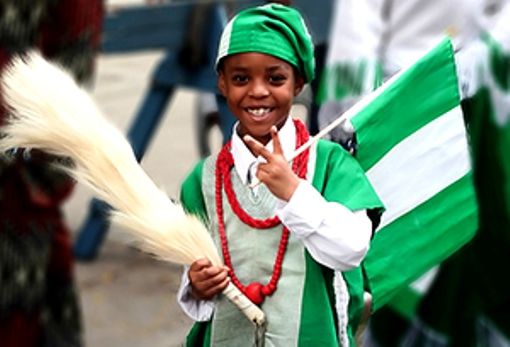
If you grew up in Nigeria, there is a good chance that Independence Day meant more than staying at home, watching television and enjoying a plate of jollof rice.
Back then, 1 October was a big deal, especially in school.
Independence Day celebrations were one of those school events we looked forward to with genuine excitement. Weeks before the actual day, you could already feel the atmosphere changing. Teachers were making plans, students were rehearsing, parents were searching for outfits and everybody was getting ready to represent Nigeria in their own little way.
And, of course, you had to look the part.
Green and white everywhere
The first order of business was always the outfit.
Green and white ribbons, dresses, shirts, skirts, trousers and accessories suddenly became very important. Some schools had a specific dress code, while others allowed students to come dressed in anything that represented Nigeria.
For some of us, the outfit was the real highlight.
There was always that student who came looking like they had been personally appointed Nigeria’s fashion ambassador. Green and white from head to toe, complete with beads, hair accessories, face paint and sometimes a tiny Nigerian flag.
Nobody wanted to be the one who forgot.
The march past
Then came the march past.
Ah, the march past!
Students would line up according to their classes or houses, trying their best to maintain perfect formation. The teachers would inspect us, adjust our lines and remind us for the hundredth time to lift our legs properly.
“Left, right, left!”
The music would start and suddenly everybody became a soldier.
Some students marched with serious concentration. Others were simply trying not to trip. And there was always that one person whose legs seemed to have a mind of their own.
But somehow, we got through it.
The Nigerian flag was sacred
The raising of the Nigerian flag was another important moment.
We learnt the national anthem and national pledge by heart. We stood at attention, sang loudly and recited the pledge with the seriousness of young citizens who believed every word.
Even if you sometimes whispered the words to the person beside you because you had forgotten a line, you still joined in.
There was something special about hearing an entire school sing the national anthem together.
Cultural performances
Independence Day was also an opportunity to celebrate Nigeria’s diversity.
Students dressed in traditional outfits representing different ethnic groups. There were Yoruba gele, Igbo wrappers, Hausa attire and colourful outfits from different parts of the country.
Then came the dancing.
Cultural dances were a major attraction. Students performed traditional dances, folk songs and dramatic presentations about Nigeria’s history and independence.
Some students were natural performers. Others were clearly there because their teachers had selected them.
Either way, we clapped for everybody.
The food was part of the celebration
Let us not pretend that food was not one of the biggest attractions.
Depending on the school, there could be jollof rice, fried rice, puff puff, chin chin, small chops, drinks and other treats.
And if your mother packed something special for you, you were immediately popular.
School celebrations had a way of turning ordinary snacks into treasures. You could trade biscuits for sweets, share drinks with your friends and somehow finish everything before the programme was even halfway done.
The speeches
Of course, there had to be speeches.
The principal would talk about Nigeria, independence, patriotism and the responsibility of young people to contribute to the country.
Sometimes, we listened attentively.
Sometimes, we were simply waiting for the next performance.
But those speeches stayed with us in ways we probably did not appreciate at the time. They introduced us to ideas about citizenship, national identity and the history of our country.
The excitement before the big day
Perhaps what made those celebrations so memorable was the anticipation.
There were rehearsals during assembly. Teachers were organising students. Parents were buying outfits. Classmates were discussing who would perform and who would march.
The whole school seemed to come alive.
There was no social media to document every outfit or performance. No Instagram Stories. No TikTok videos. No WhatsApp status updates.
We simply experienced the moment.
And maybe that is why we remember it so fondly.
Looking back
Today, Independence Day celebrations in schools may look different. Children have different interests, technology has changed the way celebrations are organised and schools have found new ways to mark national occasions.
But there is something beautiful about remembering how we celebrated when we were younger.
We dressed in green and white or cultural attires. We marched. We sang the national anthem. We recited the pledge. We danced. We ate. We laughed with our friends and went home tired but happy.